Holo-Captioning: A Comprehensive Textual View of 3D Scenes

ECCV 2026

1Visual AI Lab, The University of Hong Kong
2Frontier Robotics
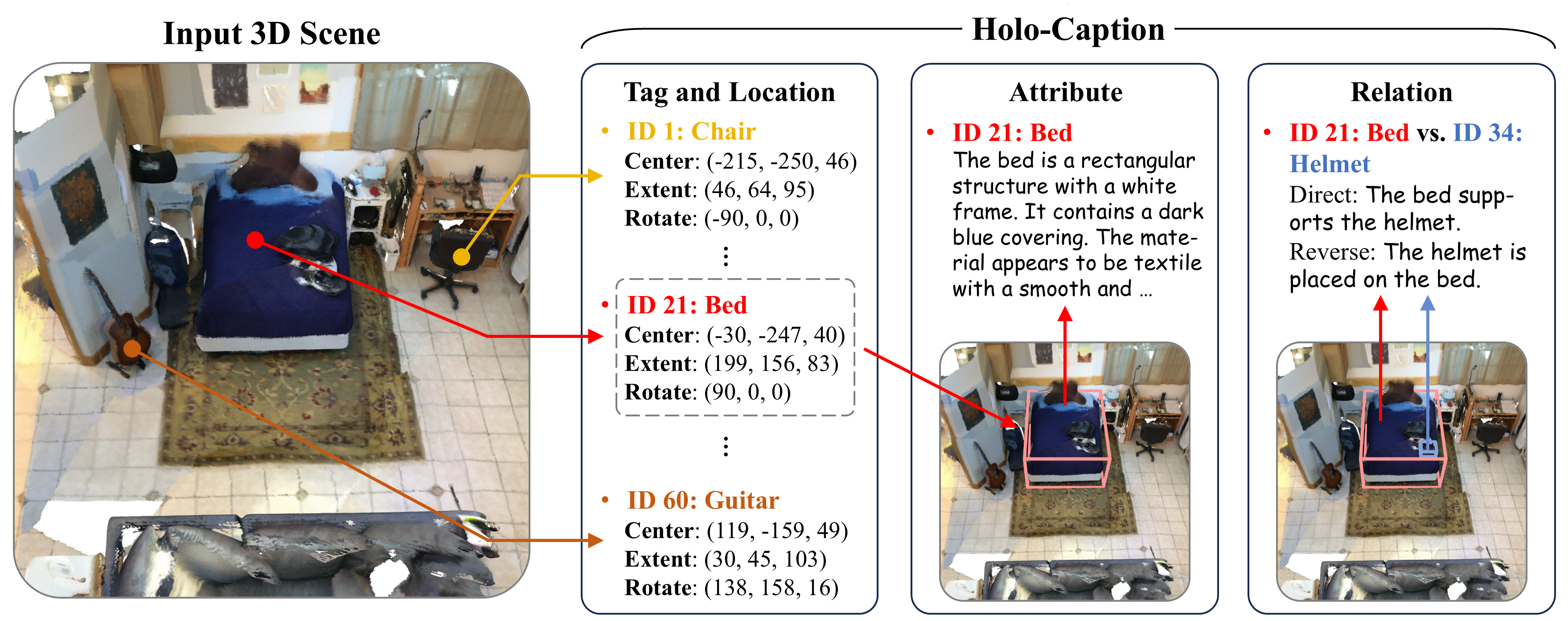
Holo-captioning task example

Abstract

This work introduces holo-captioning, a novel task that strives to seek the text equivalent of 3D scenes. As an initial step, we formulate holo-captioning as generating a structured textual description that comprehensively depicts all entities within a 3D scene, including their semantic tags, spatial locations, attributes, and inter-entity relations.

To tackle this challenging task, we develop HoloEngine, an effective captioning engine for producing detailed descriptions of individual entity instances and instance pairs, and contribute HoloScan, a large-scale benchmark comprising over 15K scenes for training and evaluation. Building upon this foundation, we propose HoloScribe, a model with an instance-aware decoupled pipeline for generating structured holo-captions, together with anchor-aware instance linking for relational instance pairs. We further introduce HoloScore, a comprehensive metric with a human-curated test set for reliable assessment. Experiments show that HoloScribe significantly outperforms state-of-the-art 3D dense captioners and 3D LLM generalists.

Our contributions are listed as follows:

  • We introduce the novel task of holo-captioning, which strives to seek the textual equivalent of 3D scenes. We formulate it as generating comprehensive structured textual descriptions that cover four fundamental dimensions, and contribute a reliable metric named HoloScore for evaluation.
  • We propose an effective instance-centric captioning engine named HoloEngine to produce high-quality holo-captions, and contribute HoloScan, a large-scale benchmark of over 15K indoor scenes spanning diverse categories for training and evaluation.
  • We propose HoloScribe, a novel model that follows an instance-aware decoupled pipeline to generate comprehensive textual descriptions element by element. To the best of our knowledge, HoloScribe is the first 3D LLM capable of jointly localizing entity instances and generating detailed descriptions in pure text form without extra detectors.
Background and Conception

Describing the 3D world with natural language is a fundamental topic in computer vision and natural language processing, benefiting diverse 3D applications such as scene modeling, vision navigation, and robotic manipulation. As a pivotal task in this field, 3D dense captioning aims to simultaneously detect and describe object instances within a 3D scene. However, existing 3D dense captioning methods are constrained by a limited range of object categories and typically produce short, coarse textual descriptions.

Driven by the rapid advances in Large Language Models, recent studies have explored structured linguistic sequences for describing 3D scenes and covering broader categories in an open-vocabulary paradigm. Nevertheless, they primarily focus on detecting architectural layouts and salient objects, overlooking fine-grained entity attributes and inter-entity relations. Motivated by these limitations, this work conceives of finding the text equivalent of a 3D scene, an ambitious yet challenging goal that aims to develop a comprehensive textual description capturing all essential elements within a 3D scene.

Task Formulation of Holo-Captioning

In this work, we formulate holo-captioning as generating a structured textual description that comprehensively depicts all entity instances within a 3D scene, including their semantic tags, spatial locations, attributes, and the relations between entities. Unlike previous 3D captioning approaches, our formulation encodes these four dimensions purely in text, resulting in a unified textual description that fully encapsulates the 3D scene. In principle, holo-captioning considers four dimensions as follows:

  • Semantic tag refers to the category label assigned to each entity instance in a 3D scene. We define entities as both architectural elements, such as floor, wall and window, and free-standing objects, such as table, bag and cabinet.
  • Spatial location refers to the position and extent of an entity instance, represented by a 3D oriented bounding box. Specifically, each box is represented as a 9-DoF vector that describes the center, size and Euler-angle orientation of the instance. By using oriented bounding boxes, a holo-caption can accurately describe instance locations and spatial extents in pure text, avoiding vague expressions such as "at the center of the scene".
  • Attribute refers to characteristics or properties that describe the appearance or state of an entity instance. This dimension encompasses a wide range of attribute types, including color, shape, material, texture and constituent parts.
  • Relation refers to the connections or interactions between two entity instances within a scene. This dimension covers a wide range of relation types, and our work focuses on those between nearby instances, as meaningful relations in static indoor scenes usually occur among spatially adjacent entities. Typical examples include spatial relations, such as "A is placed on B", and state relations, such as "A is leaning against B".

By considering these four fundamental dimensions, holo-captioning leads to a comprehensive textual description of a 3D scene. Compared to previous structured textual representations, holo-captions not only capture entity categories and locations, but also describe entity attributes and inter-entity relations, thereby enabling comprehensive 3D scene understanding. Notably, holo-captioning requires a single model to directly predict all scene elements in pure text form without relying on additional detectors or segmenters, fostering a more intrinsic alignment between 3D scenes and text.

Evaluation Metric: HoloScore

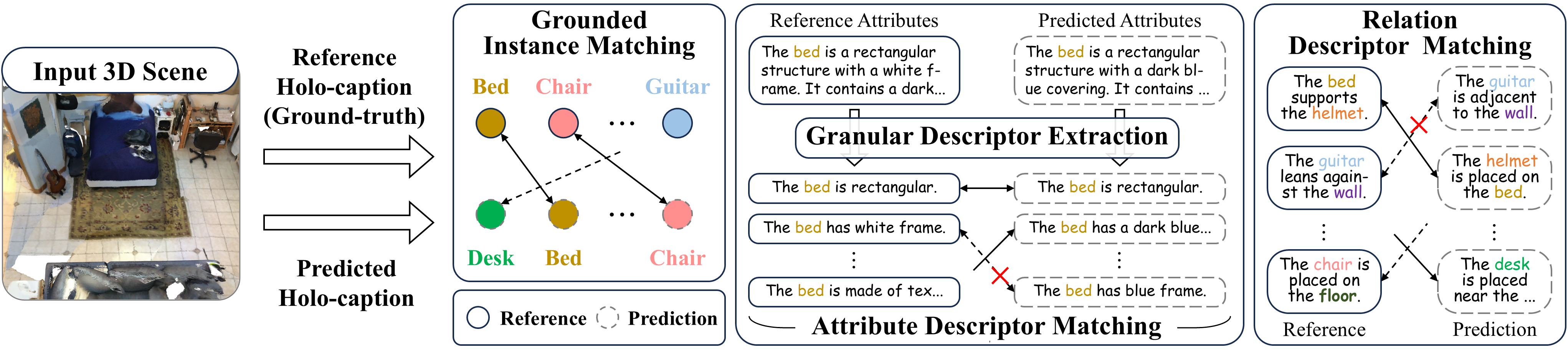
HoloScore overview

HoloScore evaluates holo-captions across four dimensions: semantic tagging, spatial localization, entity attributes, and inter-entity relations. It first performs grounded instance matching to align predicted and reference instances, then decomposes long descriptions into granular descriptors, and finally compares attribute and relation descriptors through dual descriptor matching.

Captioning Engine and Benchmark

HoloEngine is an instance-centric captioning engine that produces structured holo-captions. It projects 3D oriented bounding boxes into multi-view images, prompts MLLMs to describe target instances and instance pairs, and consolidates view-specific descriptions into holistic captions with LLMs. Based on HoloEngine, we construct HoloScan, a large-scale benchmark spanning real and synthetic indoor scenes from ScanNet, 3RScan, Matterport3D, ARKitScenes, and Structured3D. HoloScan contains over 13K training scenes, 619 validation scenes, and 83 human-curated test scenes, covering 734 entity categories across more than 15K scenes.

The Proposed Model: HoloScribe

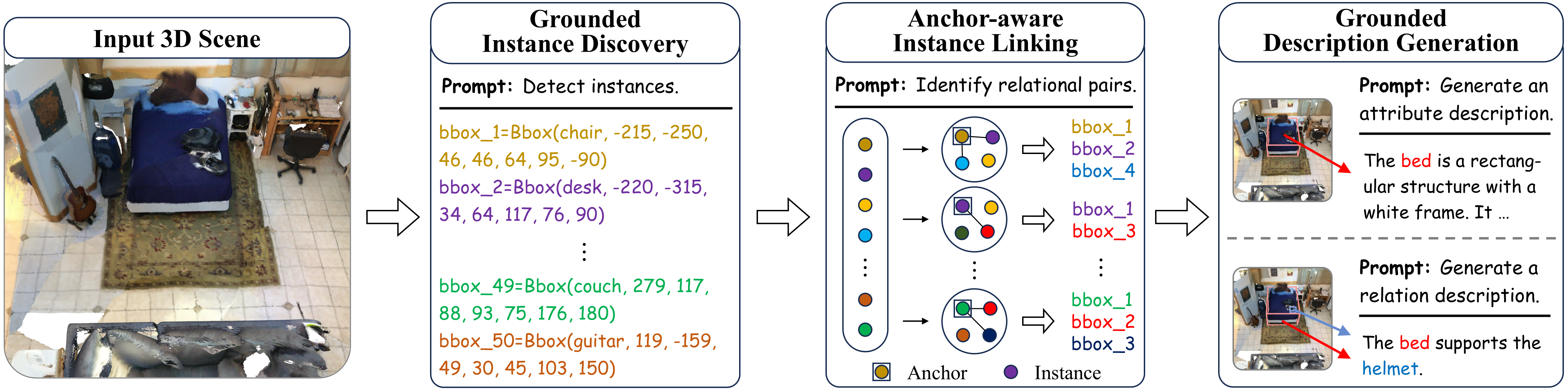
HoloScribe overview

HoloScribe follows an instance-aware decoupled pipeline. Given a 3D scene in point cloud format, it first discovers grounded entity instances, then identifies relational instance pairs through anchor-aware instance linking, and finally generates grounded attribute and relation descriptions conditioned on the discovered instances. This decomposition lets the model generate long, information-dense holo-captions element by element, while keeping entity localization, attribute description, and relation modeling grounded in a shared textual structure.

Leaderboard on the HoloScan Benchmark

(Note: Model names with the suffix "-Tuned" denote models tuned on the training set of HoloScan)

Model LLM Validation Set Test Set
Tagging Location Attribute Relation Overall Tagging Location Attribute Relation Overall
Vote2Cap-DETR - 32.87 17.00 2.49 - - 32.50 17.71 2.70 - -
Vote2Cap-DETR++ - 30.84 16.70 2.38 - - 31.39 17.04 2.67 - -
LEO Vicuna-7B 23.34 14.25 1.53 - - 25.91 14.93 1.60 - -
LL3DA OPT-1.3B 31.28 16.50 2.99 - - 31.28 16.89 3.27 - -
SpatialLM-Tuned Qwen2.5-0.5B 51.73 9.94 6.74 2.60 71.01 49.82 9.23 7.01 3.57 69.63
LL3DA-Tuned Qwen2.5-0.5B 31.25 16.50 10.36 4.83 62.94 31.28 16.88 9.54 3.97 61.67
HoloScribe (Ours) Qwen2.5-0.5B 60.43 22.33 22.52 11.08 116.36 61.83 22.75 23.72 8.74 117.04

3D Scene "Reconstruction" from Captions

HoloScribe reconstruction result

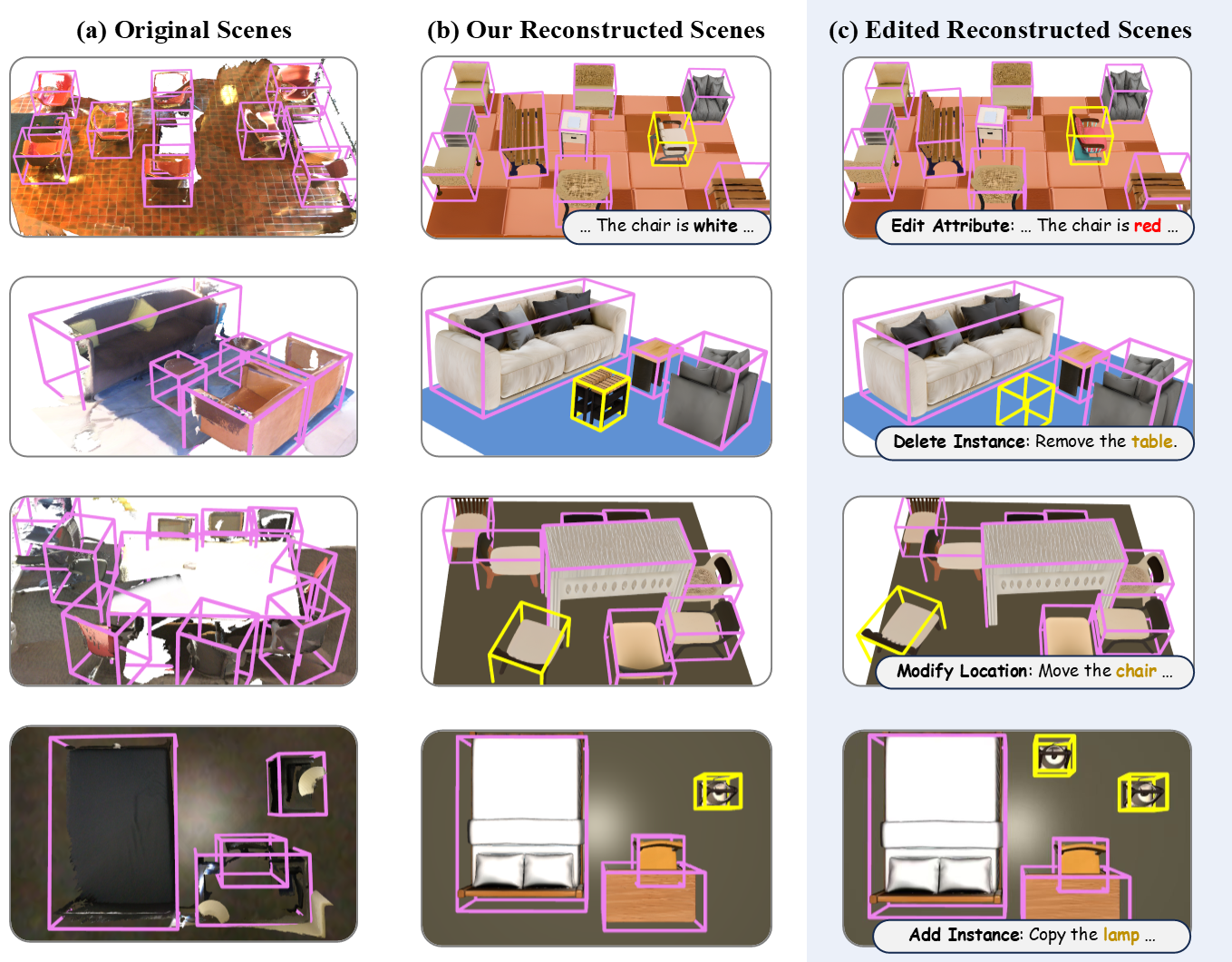
We conduct a 3D scene reconstruction experiment to qualitatively demonstrate the effectiveness and practical utility of HoloScribe. Given an input 3D scene, HoloScribe first generates a holo-caption as a textual representation of the scene. We then use Hunyuan3D to generate 3D assets from the semantic tags and attributes of entity instances extracted from the holo-caption. The predicted bounding boxes are further used to refine each instance's size and pose before placing the generated assets in 3D space to assemble the reconstructed scene. As shown in the figure, HoloScribe produces reconstructed scenes that resemble the original scenes, especially in semantic tagging and spatial localization. By modifying the generated holo-caption, the same pipeline can also support scene editing operations such as attribute editing, instance deletion, instance relocation, and instance addition.

BibTeX

@inproceedings{lin2026holocap,
    title={Holo-Captioning: A Comprehensive Textual View of 3D Scenes},
    author={Lin, Kun-Yu and Bu, Chengke and Li, Zhenguo and Han, Kai},
    booktitle={European Conference on Computer Vision},
    year={2026}
}