JoVA

Unified Multimodal Learning for Joint Video-Audio Generation and Editing

Xiaohu Huang1,* Haoyang He2,* Hao Zhou3,* Qiangpeng Yang3 Shilei Wen3 Kai Han1,†
1The University of Hong Kong    2Zhejiang University    3ByteDance
* Equal Contribution    † Corresponding Author

Abstract

In this paper, we present JoVA, a streamlined framework that unifies joint video-audio generation and editing. While existing methods often rely on fragmented, task-specific architectures or complex fusion mechanisms, JoVA employs native joint representation learning for direct video, audio, and text interaction in a dual-branch architecture. This design eliminates redundant alignment modules and effectively unifies diverse multimodal tasks within a single model. Furthermore, we utilize channel-wise conditioning for flexible image and video reference to avoid massive token expansion, alongside a mouth-area loss to enhance lip alignment. To fully empower and systematically evaluate this framework, we construct a comprehensive training corpus encompassing video-audio generation and editing datasets, and introduce unified benchmarks tailored for these multimodal tasks. Extensive experiments demonstrate that JoVA achieves state-of-the-art performance across benchmarks, establishing it as an extensible framework for versatile content creation.

Overview

JoVA capabilities overview

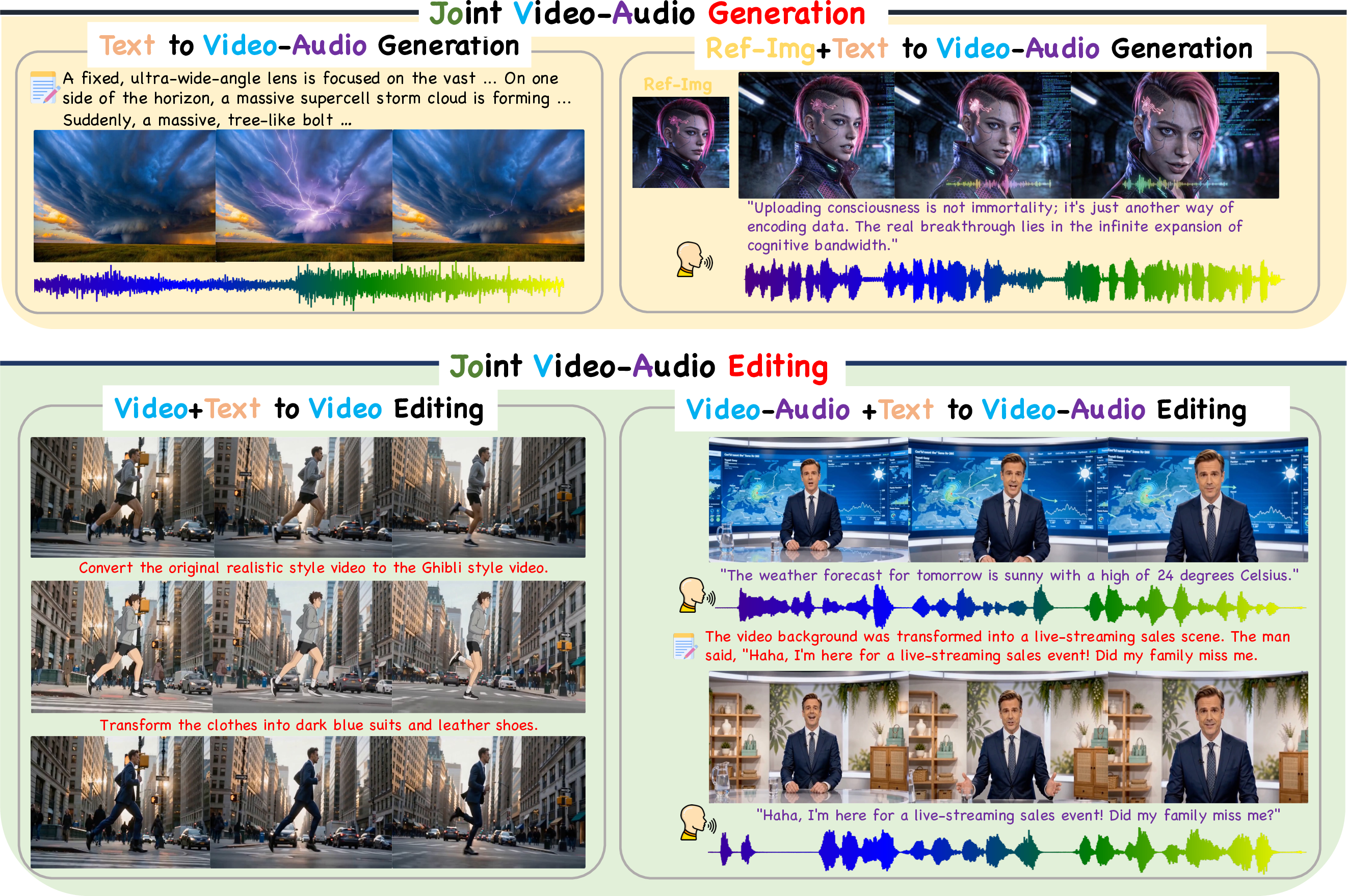
Figure 1: Overview of the JoVA framework. JoVA seamlessly unifies various multimodal tasks within a single model, including text-to-video-audio generation, reference-image-conditioned generation, video editing, and joint video-audio editing.

Demo Video

Figure 1: Demonstration of JoVA generating and editing synchronized video and audio.

Method

JoVA framework architecture

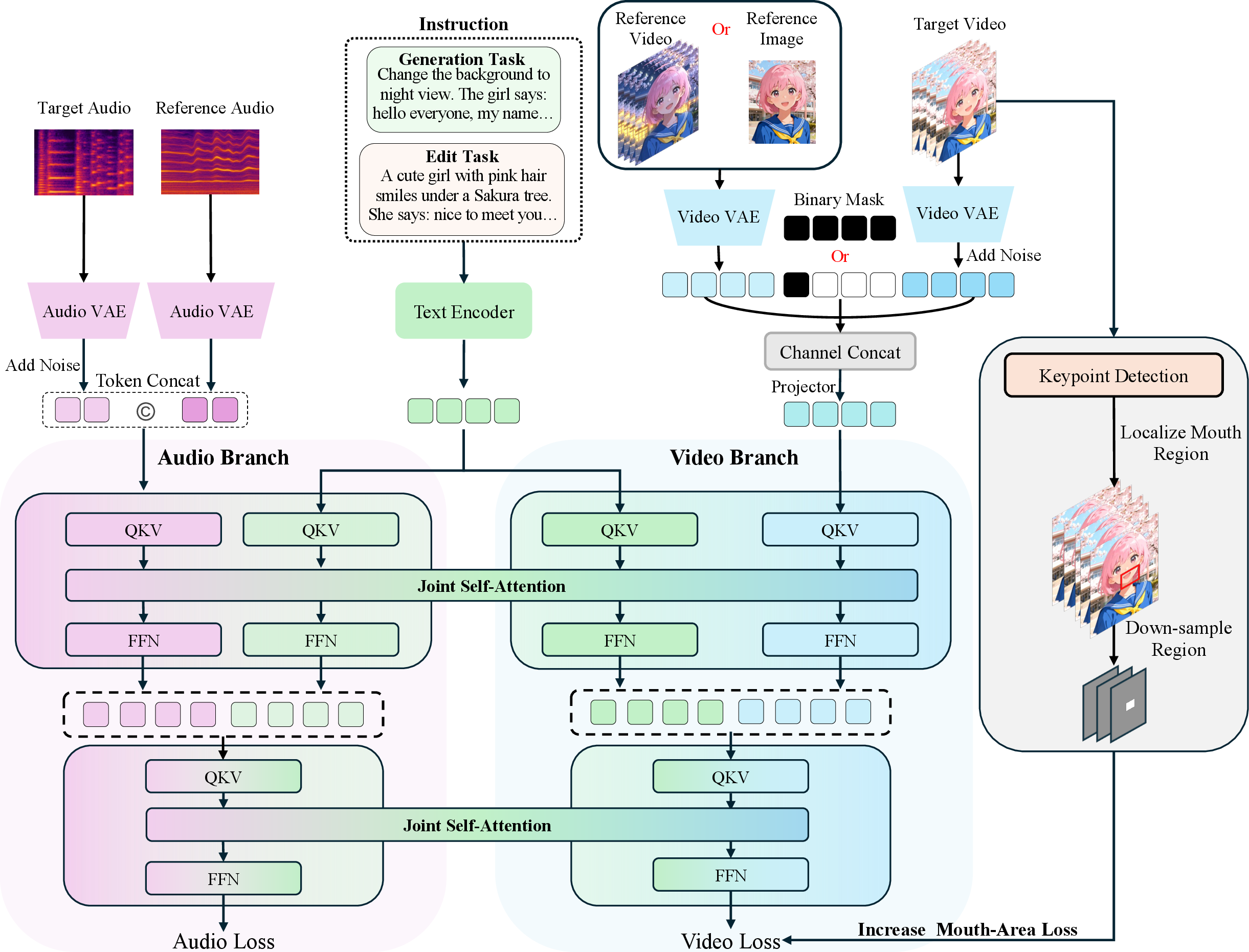
Figure 2: Overall architecture of the proposed JoVA framework. The model natively unifies video and audio generation and editing through a joint self-attention mechanism. Channel-wise concatenation with a binary mask flexibly integrates reference videos or images, while a localized mouth-area loss ensures lip-speech synchronization during training.

JoVA processes video, audio, and text tokens through native joint representation learning in a dual-branch architecture, enabling direct cross-modal interaction while eliminating redundant alignment modules. Channel-wise conditioning allows flexible image and video references without token expansion, and a mouth-area loss enhances lip synchronization for high-fidelity audio-visual generation and editing.

Construction of Data

Data Construction Pipelines

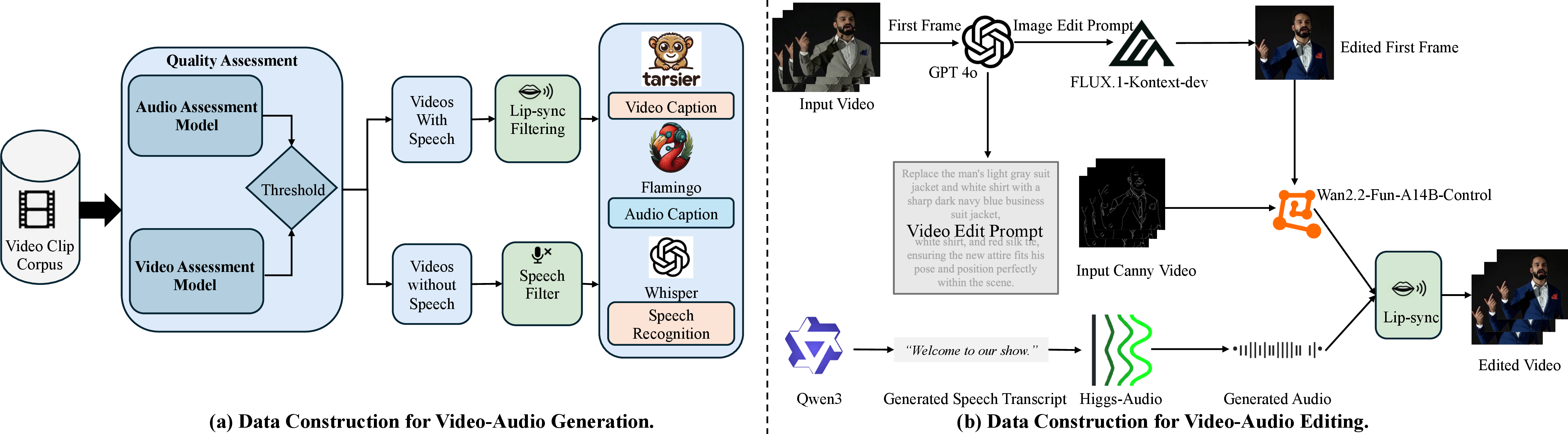
Figure 3: Overview of our training data construction pipelines. (a) Video-Audio Generation Data: raw videos undergo quality assessment, filtering, and multimodal annotation including video/audio captioning and speech recognition. (b) Video-Audio Editing Data: a workflow to synthesize paired editing data using foundation models for visual editing, audio generation, and lip-sync alignment.

Dataset distribution statistics

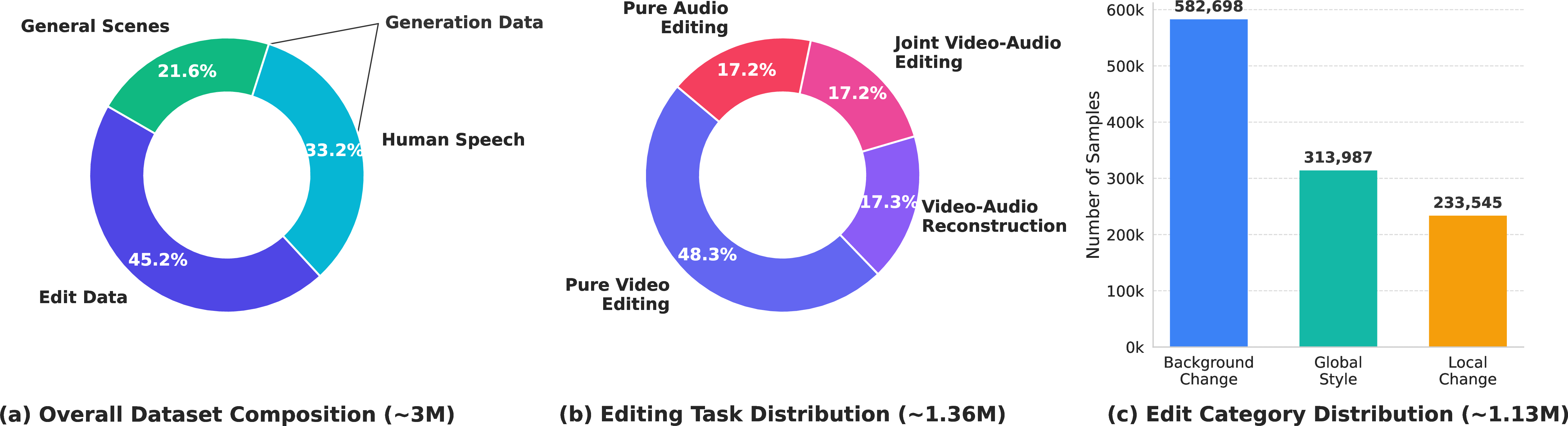
Figure 4: Detailed statistics of our video-audio-text dataset (~3M samples). The dataset covers both generation and editing data, including General Scenes (21.6%), Human Speech (33.2%), and Edit Data (45.2%).

Performance Comparison

JoVA achieves state-of-the-art performance across three benchmarks: JoVABench-Gen and JoVABench-Edit (our introduced unified benchmarks), and the public Verse-Bench.

Method LSE-C WER FD KL CS CE CU PC PQ MS AS ID
Audio-Driven Generation
FantasyTalking 3.10--------0.220.440.87
Wan-S2V 6.43--------0.820.440.72
Joint Video-Audio Generation
UniVerse-1 1.620.371.040.830.163.683.902.124.390.430.420.82
JavisDiT 1.041.081.150.640.413.363.532.314.760.200.440.30
Ovi 6.410.230.750.660.305.005.671.755.770.940.410.75
LTX-2 6.210.150.800.640.325.065.531.815.640.920.440.74
UniAVGen 5.870.170.700.620.345.326.101.626.300.900.440.75
JoVA (Ours) 6.700.190.670.640.335.406.031.696.490.970.480.78

Table 1: Performance comparison on JoVABench-Gen. The results of other methods are reproduced using their official code; audio-driven models use ground-truth audio as input. Missing metrics are denoted by "-".

Method LSE-C LSE-D FC IB-TV IS AS MS
Combined with Diff2Lip
Ditto + Diff2Lip 2.445.300.980.232.130.340.35
ICVE + Diff2Lip 2.455.350.990.181.720.360.30
InsViE + Diff2Lip 2.385.720.990.211.020.390.28
Lucy + Diff2Lip 2.345.830.980.183.010.280.30
OmniVideo + Diff2Lip 4.075.500.980.193.030.350.71
Combined with Wav2Lip
Ditto + Wav2Lip 5.852.830.980.232.330.420.46
ICVE + Wav2Lip 5.542.500.980.151.550.410.32
InsViE + Wav2Lip 5.164.400.970.181.360.370.24
Lucy + Wav2Lip 5.373.240.980.193.010.340.53
OmniVideo + Wav2Lip 4.861.750.970.182.270.370.63
JoVA (Ours) 5.881.660.980.213.210.470.66

Table 2: Performance comparison on JoVABench-Edit. As there are no directly comparable open-source baselines, we combine video-editing models with lip-sync models (Diff2Lip and Wav2Lip) using ground-truth audio, which is a strictly easier conditional task than JoVA's joint synthesis.

Method LSE-C DeSync WER FD KL CS CE CU PC PQ MS AS ID
Audio-Driven Generation
FantasyTalking 2.68---------0.070.420.87
Wan-S2V 6.49---------0.170.460.89
Joint Video-Audio Generation
UniVerse-1 1.620.230.181.252.700.163.534.612.495.200.200.470.89
JavisDiT 0.850.271.000.991.750.193.485.032.495.490.270.420.40
Ovi 6.610.490.120.972.230.203.955.602.096.200.550.470.86
JoVA (Ours) 6.650.160.110.821.390.294.475.942.476.230.750.490.86

Table 3: Performance comparison on Verse-Bench (600 image-text prompt pairs). JoVA remains strong across diverse audio-visual scenarios, achieving the best lip-sync, synchronization, and audio-quality metrics.
Generated Examples

Keep update: these examples will be continuously updated.

Qualitative results showing diversity in style, geometry, and audio-visual synchronization.
(Click on the cards to play/pause videos; hover to view full prompt)

Editing Results

JoVA edits video and audio together in one unified model. Each example shows the input and edited clip side by side — every clip carries its own audio (the original vs. the edited speech). Click a clip to play it; only one clip plays at a time.

Audio Editing

JoVA re-voices the speech — the person and scene stay the same, and the lips are re-synced to the new audio.
The sunset reflected beautifully…
Input
Edited
Bright colors swirl in the painter’s…
Input
Edited
Penguins wearing hats are famous…
Input
Edited

Background Change

The scene background is replaced while the subject holds still, with the speech re-voiced in the same edit.
Tropical beach → plain blue backdrop
Input
Edited
Cabin interior → lakeside deck
Input
Edited
Futuristic neon city at night
Input
Edited

Local Change

Fine-grained edits of local attributes while the subject keeps its pose.
Active volcanic mountains
Input
Edited
Platinum blonde hair
Input
Edited
Man → platinum blonde hair
Input
Edited

Global Style

Whole-frame artistic style transfer — the pictorial style changes while motion and pose are kept, with the speech re-voiced.
Victorian Steampunk style
Input
Edited
Ukiyoe woodblock print
Input
Edited
Hand-rendered sketch style
Input
Edited

Citation

If you find our work useful for your research, please consider citing:

@inproceedings{huang2026jova, title={JoVA: Unified Multimodal Learning for Joint Video-Audio Generation and Editing}, author={Huang, Xiaohu and He, Haoyang and Zhou, Hao and Yang, Qiangpeng and Wen, Shilei and Han, Kai}, booktitle={European Conference on Computer Vision (ECCV)}, year={2026} }