Abstract
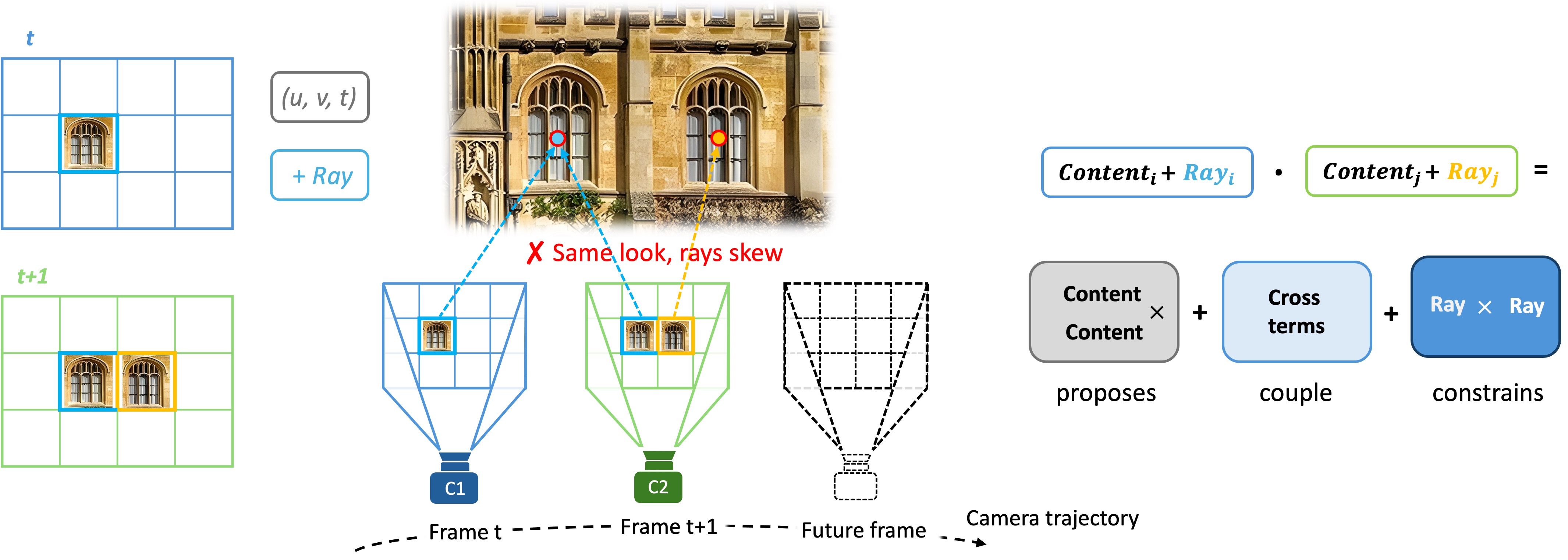
Camera control as a property of the coordinate system. SCoPE gives each token its camera ray as a second address. Ray geometry inside attention resolves appearance ambiguity and follows the target trajectory across diverse scenes.
A lightweight Normalize–Gate–Inject path supports both metric and up-to-scale poses while preserving pretrained RoPE bit-exactly. The same geometry improves controllability and video fidelity at both 5B and 14B scales.
Video Overview
02:00SCoPE in two minutes.A concise introduction to the motivation, ray-based positional encoding, qualitative results, and evaluation.
Key Ideas
- A second positional coordinate. The world point a token will depict is unknown before generation, but its camera ray is fixed by the user's trajectory. SCoPE uses that ray as the token's second address.
- Geometry inside attention. Adding ray features to pretrained queries and keys gives the attention score a ray-only term. Its canonical form is the reciprocal product of line geometry, which measures how nearly two lines of sight meet.
- A minimal, stable retrofit. Normalize-Gate-Inject works across metric and up-to-scale poses while preserving RoPE bit-exactly. SCoPE starts from the unchanged pretrained DiT, adds under 0.1% parameters, and improves both 5B and 14B models.
Scenes
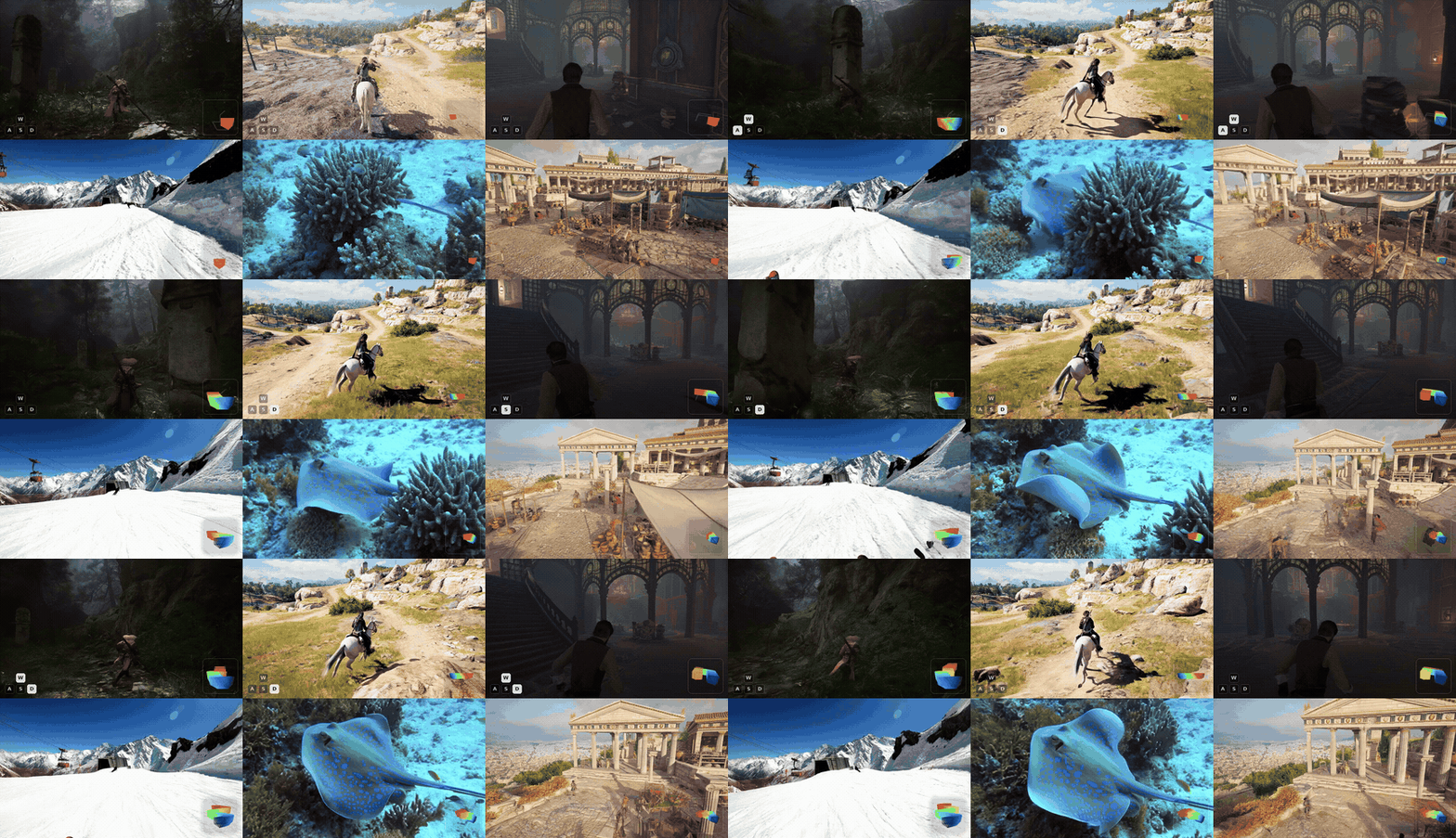
One generated scene browsed under six different camera trajectories. The inset visualizes the commanded camera path.
Motions
WASD inputs drive the camera trajectory that moves the third-person subject. Overlay keys reflect the per-frame motion.
07 / Emergent property
Revisit consistency,by construction.
Turn 90°, pass through a gateway, then return: previously seen regions remain anchored instead of drifting.
The outbound and return views reuse the same ray coordinates, addressing the scene from the same geometric positions.
Encoding, not memorization.Revisit consistency follows from the coordinate system itself—not from an added memory mechanism.
Real-World Scenes
Diverse real captures driven along varied camera paths from a single frame.
In-the-Wild Videos
Everyday footage re-rendered under controllable camera motion.
Stylized & Artistic Scenes
Illustrated and painterly inputs animated with 3D-consistent camera control.
Citation
@article{yin2026scope,
  title   = {SCoPE: Sightline-Coordinate Positional Encoding for Video Diffusion Transformers},
  author  = {Yin, Minghao and Lu, Jiahao and Hu, Wenbo and Zhao, Wang and Shan, Ying and Han, Kai},
  journal = {arXiv preprint arXiv:2606.27345},
  year    = {2026}
}